
For decades, celebrity culture was built on distance.
The biggest stars felt larger than life. Their images were polished, carefully managed, and often impossible to relate to. Fans admired them from afar, seeing only the version presented through television interviews, magazine covers, and red-carpet appearances.
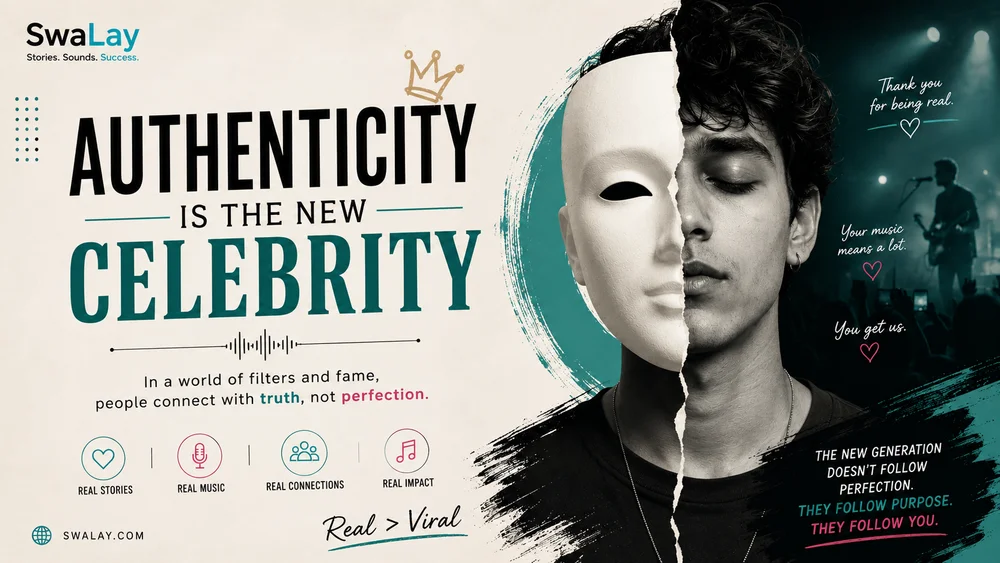
Today, that formula is changing.
The modern audience is no longer searching for perfection.
It is searching for authenticity.
In an era dominated by social media, streaming platforms, and direct artist-to-fan communication, listeners increasingly value honesty over image, personality over perfection, and connection over celebrity.
The result is a cultural shift that is transforming the music industry.
The End of the Untouchable Star
The internet changed more than just how music is distributed.
It changed how people relate to artists.
Fans now expect access.
They follow artists on social media, watch behind-the-scenes content, interact through live streams, and gain insight into their everyday lives.
This level of visibility has made traditional celebrity culture feel less relevant.
Audiences no longer want artists who appear flawless.
They want artists who appear human.
The appeal of perfection is fading.
The appeal of relatability is growing.
Why Gen Z Values Authenticity
No generation has embraced authenticity more strongly than Gen Z.
Growing up online has made younger audiences highly aware of curated content and manufactured images.
They can often recognise when something feels forced.
As a result, they gravitate toward artists who seem genuine.
Artists who openly discuss uncertainty, vulnerability, creative struggles, and personal experiences often build stronger relationships with listeners.
Authenticity creates trust.
And trust creates loyalty.
In many cases, loyal communities are far more valuable than temporary attention.
The Rise of Emotionally Honest Music
This shift is clearly visible in the success of independent artists.
Musicians such as Anuv Jain, Prateek Kuhad, Talwiinder, Aditya Rikhari, and many others have built audiences through emotional honesty rather than larger-than-life personas.
Their music feels personal.
Their stories feel relatable.
Their lyrics often reflect real emotions rather than manufactured narratives.
Listeners do not simply consume the music.
They connect with it.
The artist becomes less of a celebrity and more of a voice that understands their experiences.
Social Media's Unexpected Effect
Ironically, the same platforms that encourage self-promotion have also increased the value of authenticity.
Audiences are exposed to thousands of pieces of content every day.
They quickly scroll past anything that feels artificial.
The content that often performs best is content that feels honest.
A simple acoustic performance can generate more engagement than a heavily produced campaign.
A genuine story can resonate more deeply than a carefully crafted marketing strategy.
Authenticity cuts through the noise because it feels real.
Why Independent Artists Have an Advantage
Independent artists are particularly well positioned in this environment.
Without the pressure to fit traditional industry expectations, they often have greater freedom to express themselves authentically.
They can experiment.
They can tell personal stories.
They can build direct relationships with audiences.
Most importantly, they can create without constantly chasing a predefined image.
This authenticity often becomes their greatest competitive advantage.
In an industry crowded with content, being genuine can be more powerful than being famous.
The Future of Artist-Fan Relationships
The future of music may not belong to the most visible artists.
It may belong to the most relatable ones.
Listeners are increasingly supporting artists who make them feel seen, understood, and connected.
This relationship goes beyond streaming numbers.
It becomes a community.
It becomes a conversation.
And conversations last longer than trends.
The SwaLay Perspective
At SwaLay, we believe music's greatest strength has never been celebrity.
It has always been a connection.
Technology will continue to evolve.
Platforms will continue to change.
But the desire for genuine human expression remains timeless.
The artists who thrive in the coming years may not be those with the biggest marketing budgets or the loudest campaigns.
They may be the artists willing to be themselves.
Because in a world full of carefully constructed images, authenticity stands out.
And increasingly, authenticity is becoming the new celebrity.