
For decades, an artist's biggest challenge was getting a song onto the shelves.
Today, the shelves are overflowing.
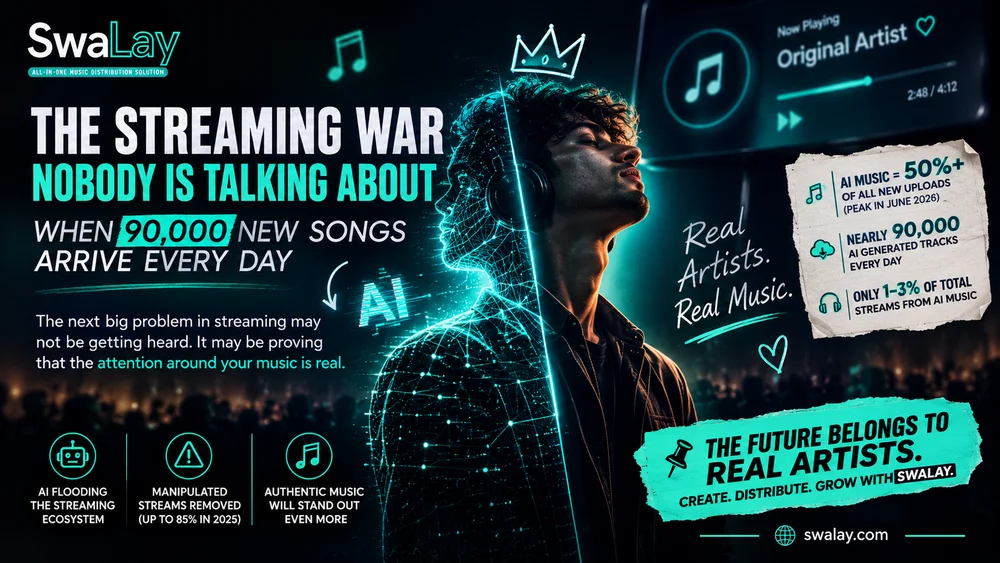
Deezer has revealed that it is now receiving nearly 90,000 fully AI generated tracks every day, with AI music accounting for more than half of all new music deliveries during peak periods in June 2026. That means the biggest challenge facing streaming platforms may no longer be discovering enough music. It may be deciding which music deserves attention.
But there is an even more unexpected part of the story.
Despite the enormous number of AI generated uploads, Deezer says fully AI generated music represents only around 1% to 3% of total streams on the platform. The company also found that up to 85% of streams generated by fully AI tracks were fraudulent in 2025, with manipulated streams removed from royalty calculations.
For independent artists, this matters enormously.
Streaming platforms operate within a limited attention economy. Every recommendation, playlist placement and listener session represents an opportunity for a song to be discovered. When artificial content or manipulated streams enter that ecosystem, the concern is not simply that there are more songs. The deeper issue is that genuine artists can find themselves competing for attention against systems designed to manufacture volume.
Deezer has responded by detecting and tagging AI generated music, excluding detected tracks from algorithmic and editorial recommendations, and taking stronger action against fraudulent AI content. Its detection technology reportedly has 99.8% accuracy.
The development also points towards a larger shift in the music business.
Trust is becoming part of music distribution.
As the number of releases continues to explode, artists will increasingly need more than a digital upload. They will need accurate metadata, legitimate rights, transparent reporting and responsible distribution practices.
For independent musicians, the lesson is simple: in an internet full of synthetic noise, authenticity could become one of the most valuable assets an artist owns.
The future of streaming may not belong to whoever releases the most music.
It may belong to whoever can prove that real people are listening.