
For years, the music industry has obsessed over playlists, short-form videos, recommendation algorithms and streaming numbers.
But one of the most powerful ways a listener connects with a song may be sitting quietly underneath all of them.
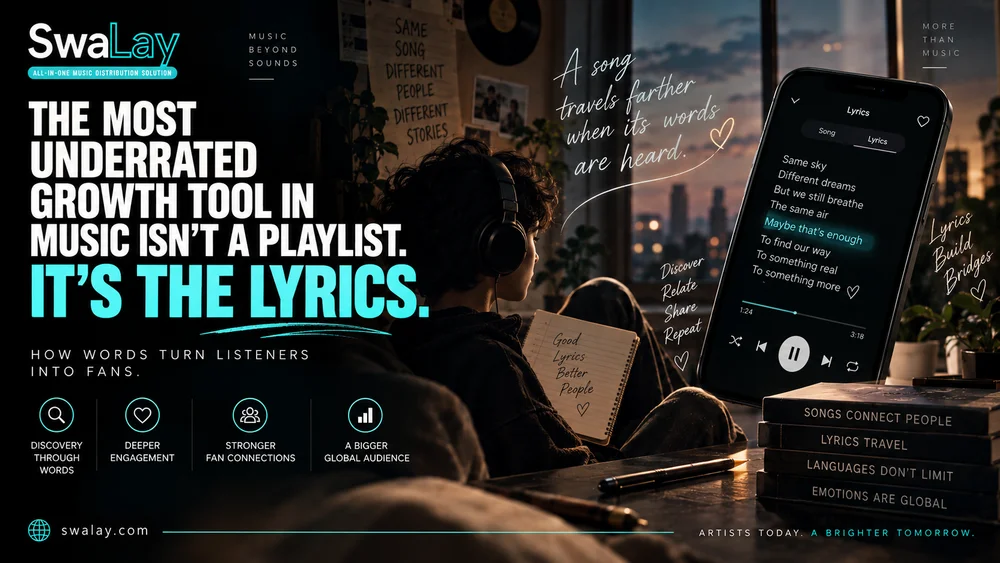
The words.
Lyrics are becoming more than something listeners read while a song plays. They are increasingly becoming a discovery, engagement and fandom layer around the music itself.
Recent data shared by Musixmatch suggests that 88% of premium subscribers actively use lyrics, while tracks with lyrics generate 3.5 times more saves. Musixmatch's chief product officer also argues that lyrics can turn passive listening into a more active relationship with an artist.
That changes the way artists should think about a release.
A Song Can Be Heard Before It Is Understood
Think about how a song travels today.
Someone hears a line in a Reel.
They search those words.
They find the track.
They screenshot the lyric.
They share it.
Someone else relates to the same sentence and saves the song.
Suddenly, a lyric has done something an advertisement often cannot do.
It has given the listener a reason to remember the artist.
Musixmatch says 81% of listeners search for lyrics online, making lyric availability another potential pathway to discovery.
And that matters enormously during release week, when an artist is trying to convert initial curiosity into repeat listening.
The Hidden Infrastructure Behind a Song
There is an even bigger story here.
Most artists think of a release as an audio file, cover artwork and a few pieces of metadata.
But the modern music release is becoming much more layered.
Lyrics need to be transcribed, timed, credited, translated and delivered across different services. Metadata needs to remain accurate so that the right artist, songwriter and rights holders are connected to the right recording. Industry research also identifies metadata as important to both discoverability and remuneration.
Musixmatch recently launched Pro for Labels, specifically to help labels manage and distribute lyrics across large catalogues, describing the process as a way to support discovery and deeper fan engagement.
That is a revealing development.
The industry is investing in the information around the music, not just the music itself.
India Could Benefit Even More
This becomes particularly interesting for Indian independent artists.
India's music ecosystem is increasingly crossing language boundaries. Spotify's 2026 India Loud & Clear report found that more than 40% of royalties generated by Indian artists on Spotify in 2025 came from listeners outside India. Regional-language royalties also grew sharply, including Telugu at more than 120% and Marathi at nearly 50%.
When a song travels across languages, lyrics and translations become part of the bridge.
A listener does not necessarily need to understand the original language to connect with the emotion.
The words can travel with the song.
For an independent artist, that means lyrics should not be treated as an afterthought uploaded days after release.
They are part of the release strategy.
The Next Discovery Engine May Be Sitting Inside the Song
Streaming platforms decide what gets recommended.
Social platforms decide what gets attention.
But lyrics can influence what happens after someone actually presses play.
They can turn a listener into a participant.
And eventually, a participant into a fan.
That is why the next generation of independent music distribution may need to think beyond audio delivery.
The future release is not just a song.
It is the song, its words, its credits, its translations, its metadata and every piece of information that helps a listener understand why they should come back.
For companies like SwaLay, this creates a larger opportunity around the complete digital identity of an artist and their catalogue.
Because in an industry obsessed with getting people to press play, there is another question worth asking:
What makes them stay?
Sometimes, it is just one line.
And that line could be the beginning of a fandom.