
Never before has a generation been so connected.
Messages arrive instantly. Social media allows people to interact across continents. Video calls can bridge thousands of miles in seconds.
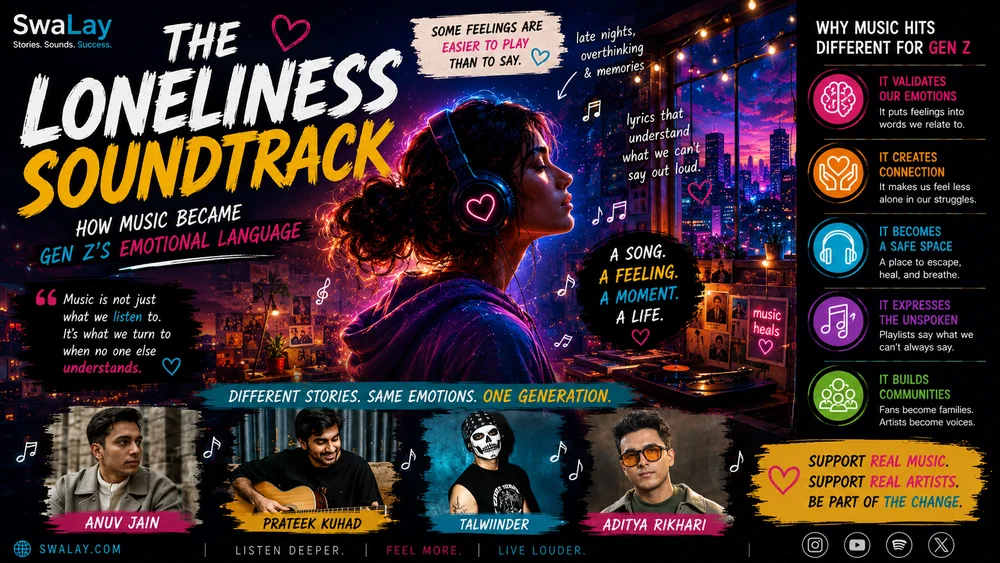
Yet despite living in the most connected era in history, many young people report feeling increasingly lonely.
It is one of the defining contradictions of modern life.
And in the middle of that contradiction, music has quietly become something much more powerful than entertainment.
For Gen Z, music is no longer just something to listen to.
It has become a language.
A way of processing emotions.
A source of comfort.
And for many, a companion during moments when words simply aren't enough.
The Generation That Feels Everything
Gen Z has grown up in a world of constant change.
Economic uncertainty, social pressures, global crises, digital overload, and the expectation of always being connected have shaped an entire generation's experience.
While previous generations often hid vulnerability, today's young listeners are increasingly open about discussing mental health, loneliness, anxiety, and emotional well-being.
As a result, they are drawn toward music that feels honest.
Not perfect.
Not polished.
Just real.
Songs that acknowledge uncertainty often resonate more deeply than songs pretending everything is fine.
Why Emotional Music Is Thriving
Over the last decade, artists like Anuv Jain, Prateek Kuhad, Talwiinder, Aditya Rikhari, and Mitraz have built loyal audiences by embracing vulnerability.
Their music rarely relies on grand spectacle.
Instead, it focuses on small moments.
Missed conversations.
Unspoken feelings.
Distance.
Nostalgia.
Heartbreak.
Hope.
These themes feel familiar because they reflect experiences many listeners face every day.
The success of such artists reveals something important:
People are not simply searching for music.
They are searching for understanding.
Playlists Have Become Personal Diaries
A generation ago, people kept journals.
Today, many keep playlists.
Listeners create collections of songs for heartbreak, motivation, healing, late-night thoughts, long drives, and moments they cannot explain.
These playlists often communicate emotions more effectively than conversations.
A song can express what someone is struggling to say.
A lyric can validate feelings that seem impossible to describe.
Music has become a form of emotional documentation.
A soundtrack to personal experiences.
When Music Feels Like Friendship
One of music's most unique qualities is its ability to create connection without direct interaction.
Listeners may never meet an artist.
Yet they often feel understood by them.
A song written by a stranger can feel intensely personal.
This is especially important during periods of loneliness.
Music reminds people that someone else has experienced similar emotions.
Someone else has felt lost.
Someone else has questioned themselves.
Someone else has survived difficult moments.
That realisation can be surprisingly powerful.
The Rise of Intentional Listening
While digital platforms encourage constant consumption, many young listeners are using music in a more intentional way.
Music is becoming part of:
Mental wellness routines
Self-reflection
Emotional processing
Study sessions
Creative expression
Personal growth
The relationship between listener and artist is evolving beyond entertainment.
It is becoming emotional support.
Not in place of human connection, but alongside it.
Why Independent Artists Matter
Many of the artists leading this movement come from the independent music scene.
Without the pressure to fit traditional commercial formulas, they often explore emotions with greater honesty and depth.
Independent music has become a space where vulnerability is not a weakness.
It is a strength.
Listeners reward authenticity because they recognise it immediately.
In a world full of filters, carefully curated identities, and endless content, sincerity stands out.
That is one reason independent artists continue to build such passionate communities.
The SwaLay Perspective
At SwaLay, we believe music has always been about connection.
But today's generation is using music in ways that feel uniquely personal.
For Gen Z, songs are not just consumed.
They are living.
Shared.
Saved.
Revisited.
And remembered....
Music has become a language for emotions that often feel too complex for ordinary conversation.
It provides comfort during uncertainty, companionship during loneliness, and understanding during moments of self-discovery.
In a world filled with noise, that may be music's most important role yet.
Because sometimes the right song does more than entertain.
Sometimes it makes people feel less alone.
And for an entire generation searching for connection, that might be the most powerful thing music can do.