
When Samay Raina's India's Got Latent returned with Season 2, Episode 1, audiences expected outrageous comedy, unexpected contestants, and viral moments. They got all of that, but what no one anticipated was that one of the episode's biggest stars wouldn't be a contestant or a celebrity guest. It would be an AI-generated song.
The catchy track, remembered by fans for its infectious line "Wah kya scene hai... meri chai ki tapri pe...", quickly escaped the boundaries of the show. Within hours of the episode's release, social media platforms were flooded with reels, memes, edits, and fan recreations using the song. What began as a humorous background piece became one of the internet's most recognisable audio trends of the week.
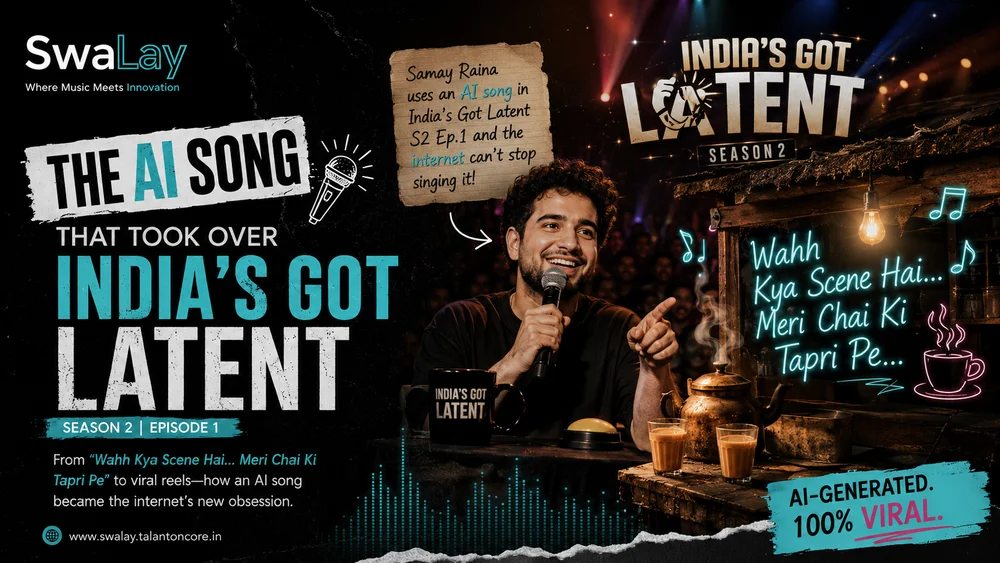
The phenomenon highlights a growing shift in digital entertainment. AI-generated music is no longer limited to experimental creators or niche tech communities. It is now finding space in mainstream comedy, web shows, advertising, and short-form content, where memorable hooks often matter more than traditional music production.
The brilliance of the "chai ki tapri" song lies in its simplicity. With playful lyrics, an instantly hummable melody, and a distinctly desi vibe, it perfectly complements the chaotic humour that has become synonymous with India's Got Latent. Viewers didn't just hear the song; they remembered it, quoted it, and began creating content around it.
For creators, this moment demonstrates how AI can become a powerful creative collaborator rather than simply a replacement for musicians. By rapidly generating humorous concepts, catchy melodies, or parody tracks, AI enables creators to experiment with ideas that can resonate with millions within days.
However, the viral success also revives an important conversation within the music industry. As AI-generated songs become increasingly common, questions surrounding copyright ownership, artist compensation, ethical usage, and transparency continue to grow. Industry experts believe that while AI can accelerate creativity, human musicians, lyricists, and composers will remain essential in shaping authentic musical experiences.
The success of the "Meri Chai Ki Tapri" track proves that audiences care less about how a song is made and more about how it makes them feel. If it entertains, sparks conversation, and becomes part of internet culture, it has already achieved what every piece of content hopes for: relevance.
With India's Got Latent once again dominating online conversations, one thing has become clear: AI music has officially stepped into mainstream Indian entertainment. Whether it's comedy shows, YouTube content, or the next generation of viral internet trends, AI-generated songs are no longer a novelty; they're becoming part of the soundtrack of digital culture.
As creators continue to explore this technology, the line between artificial intelligence and artistic expression will only become more fascinating, and the next viral hit might just be written by an algorithm, perfected by humans, and loved by millions.