
The music industry thought it was watching a turning point.
On September 9, AI music company Suno launched its new v6 family of models, developed with licensed music from partners including Warner Music Group, BMG and Believe. The move appeared to signal a significant change in the relationship between generative AI and the music business: instead of building the future around unlicensed recordings, AI companies could work with rights holders and create commercial models around licensed music.
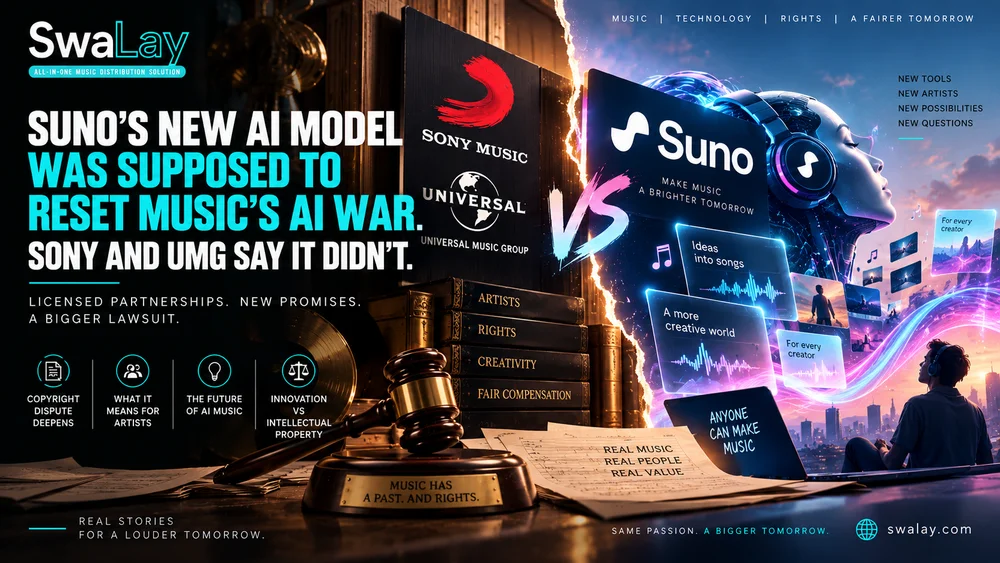
Then came the lawsuit.
Sony Music Entertainment and Universal Music Group have filed a new 45-page complaint in a Massachusetts federal court, alleging that Suno's new v6 models still benefit from copyright infringement connected to its earlier systems. The labels identify 60,202 sound recordings in the new action and argue that training a new model using outputs from earlier models does not erase the alleged infringement.
That argument introduces a fascinating question for the entire AI music industry:
Can a new model really be considered a clean beginning if its development is connected to an older model whose training is being challenged?
Suno disputes the labels' position. The company says v6 was trained from scratch using licensed partner content, community interactions and accumulated technical learnings, and that its new system does not use Sony or Universal's repertoire as training data.
The dispute therefore goes beyond one company or one model.
It could help define how the industry treats model lineage, licensed training data, derivative AI systems and the value of copyrighted recordings in machine learning.
And there is an even bigger signal for artists.
The arrival of licensing agreements with Warner, BMG and Believe shows that a commercial framework for AI music is possible. But the new lawsuit demonstrates that simply creating a licensed future may not settle questions surrounding an unlicensed past.
For independent artists, this is a story worth watching closely.
Because the next chapter of AI music may not be decided by how realistic the technology becomes.
It may be decided by who has the right to teach it music in the first place.