
You open your favorite streaming app.
A playlist appears.
A song starts playing.
You like it.
The next recommendation feels surprisingly perfect.
Then another.
And another.
Soon, hours have passed listening to music that seems tailor-made for your taste.
It feels personal.
It feels natural.
But here's the question few listeners stop to ask:
Did you choose the music?
Or did the algorithm choose it for you?
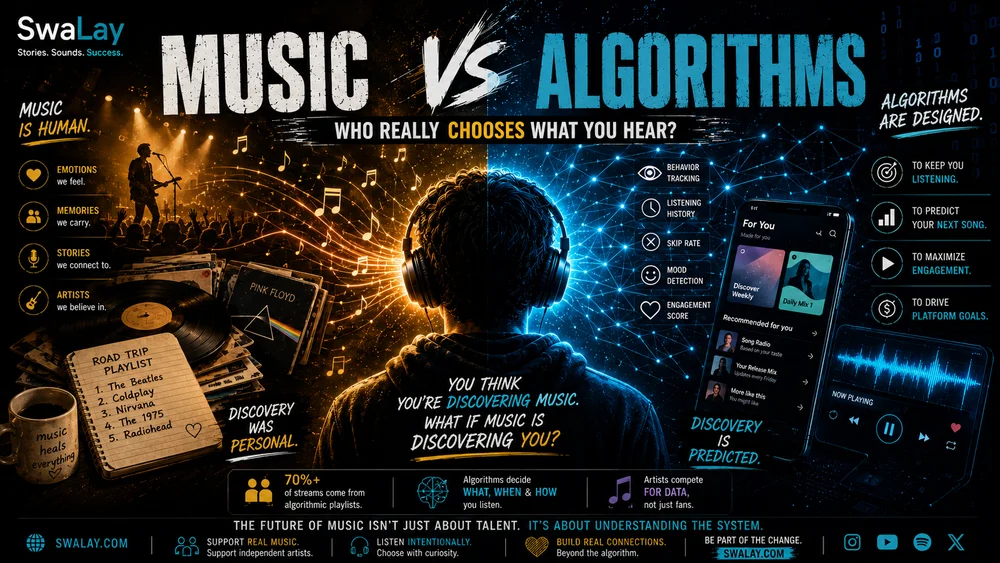
In today's streaming era, music discovery is no longer guided primarily by radio hosts, record stores, friends, or even artists themselves. Increasingly, algorithms determine what we hear, what becomes popular, and which artists get discovered.
The result is a new reality where technology influences music culture more than ever before.
The Rise of Algorithmic Listening
Streaming platforms have transformed how people consume music.
Instead of purchasing albums or building music libraries manually, listeners now have access to millions of songs instantly.
To help navigate this overwhelming volume of content, platforms rely on recommendation systems.
These algorithms analyze:
Listening history
Skipped songs
Repeat plays
Search behavior
Playlist activity
Listening time
Device usage
Every action becomes data.
Every piece of data helps platforms predict what you might want to hear next.
The goal is simple:
Keep listeners engaged.
Discovery Has Changed Forever
For decades, music discovery was often unpredictable.
People found artists through radio stations, live performances, magazines, television, record stores, or recommendations from friends.
Discovery felt personal.
It involved curiosity and exploration.
Today, discovery is increasingly automated.
Platforms predict preferences before listeners actively search for them.
In many cases, people discover songs because an algorithm decided they were likely to enjoy them.
Convenient?
Absolutely.
But it raises an important question.
If algorithms constantly reinforce existing preferences, are listeners discovering new music—or simply hearing more of what they already like?
The Artist Perspective
Algorithms don't only influence listeners.
They influence artists too.
Many musicians now consider platform behavior when creating and releasing music.
Some artists optimize songs for playlist placement.
Others focus on creating stronger openings to prevent listeners from skipping tracks.
Release strategies are often designed around platform visibility.
This doesn't mean creativity has disappeared.
But it does mean technology increasingly shapes artistic decisions.
For independent artists, understanding algorithms has become almost as important as understanding music itself.
Visibility often depends on platform performance.
And platform performance depends on algorithmic approval.
When Popularity Becomes Predictable
One concern critics often raise is that algorithms can create feedback loops.
Popular songs receive more visibility.
More visibility generates more streams.
More streams increase recommendations.
The cycle repeats.
This can make it difficult for emerging artists to compete, regardless of talent.
While streaming platforms have introduced countless listeners to independent music, they also possess enormous influence over which artists receive attention.
In many ways, algorithms have become the new gatekeepers of the music industry.
The Benefits We Often Forget
Despite concerns, algorithms are not inherently negative.
They have helped listeners discover artists from different countries, genres, and cultures.
Independent musicians can now reach global audiences without traditional industry support.
Niche genres thrive in ways that were once impossible.
For many listeners, recommendation systems have expanded musical horizons.
The issue is not whether algorithms are useful.
The issue is understanding how much influence they have.
Are We Losing Intentional Listening?
Perhaps the biggest cultural shift is not technological.
It is behavioral.
Music consumption has become increasingly passive.
Autoplay continues after songs end.
Recommendations arrive automatically.
Playlists replace deliberate choices.
Many listeners spend less time actively searching and more time accepting suggestions.
As convenience grows, intentional listening sometimes declines.
The danger is not that algorithms exist.
The danger is forgetting that they are there.
The SwaLay Perspective
At SwaLay, we believe technology has made music more accessible than ever before.
But great music has always been about more than convenience.
It is about discovery.
Curiosity.
Connection.
Algorithms can help listeners find music.
They should not become the only way listeners experience it.
The future of music should combine the best of both worlds: the intelligence of technology and the unpredictability of human discovery.
Because some of the most meaningful songs we encounter are not the ones an algorithm predicts.
They are the ones we stumble upon unexpectedly.
And sometimes, those discoveries change everything.
The next time a platform recommends your favorite new song, take a moment to ask yourself:
Did you find the music?
Or did the music find you?