
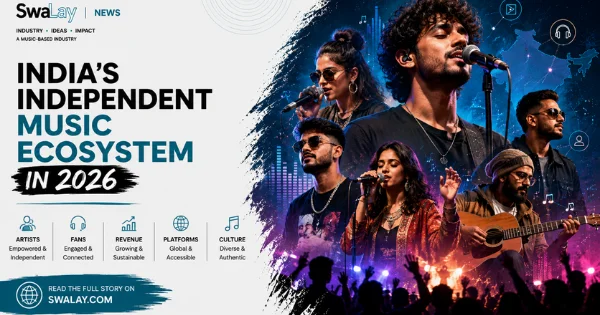
India's independent music scene is no longer the underdog. It is becoming the backbone of the country's rapidly growing digital music economy. While Bollywood soundtracks and major label releases continue to dominate headlines, the numbers tell a different story: independent artists are growing faster, reaching more listeners, and building more sustainable careers than at any point in India's music history.
At SwaLay Digital, we have a front-row seat to this transformation. With over 10,000 tracks distributed across 40+ global platforms, serving artists in Hindi, Punjabi, Bhojpuri, and dozens of regional Indian languages, we see the data every day. Here is what the numbers actually look like in 2026.
The global context: streaming revenue hit record highs
According to IFPI's Global Music Report, streaming platforms generated $39.5 billion in global recorded music revenue in 2025, growing 9.4% year over year. Spotify alone paid out a record $11 billion to the music industry in 2025, bringing its cumulative all-time payouts to $70 billion. Approximately 1,500 artists worldwide generated over $1 million in annual royalties from Spotify alone, and more than 13,800 artists earned at least $100,000.
India is one of the fastest-growing music markets in the world. JioSaavn, Gaana, Spotify India, YouTube Music, and Amazon Music India have created unprecedented access to listeners across tier-1, tier-2, and tier-3 cities. The smartphone revolution and affordable data plans, largely driven by Jio's entry into the market, have put streaming into the hands of hundreds of millions of Indians who previously had no access to digital music platforms.
What does a stream actually pay in India?
This is the question every artist asks, and the honest answer is: it depends. No streaming platform pays a fixed rate per stream. They operate on a royalty pool system where the platform's total monthly revenue (subscriptions plus advertising) is pooled and distributed to rights holders based on their share of total streams.
In 2026, approximate per-stream rates look like this globally: Spotify pays roughly $0.003 to $0.005 per stream on average, Apple Music pays approximately $0.007 to $0.01, Amazon Music pays $0.004 to $0.008, and YouTube Art Tracks pays $0.0002 to $0.0005.
In India specifically, per-stream rates are lower than global averages because the average revenue per user (ARPU) is lower. Indian streams on Spotify's free tier generate significantly less revenue than a premium subscriber stream from the United States or the United Kingdom. This is why an Indian artist might see ₹0.15 to ₹0.40 per stream on Spotify India, compared to ₹0.60 or more for the same stream from a US listener.
For independent artists using flat-fee distributors like SwaLay, the advantage is that you keep the largest share of whatever the platform pays. Major label artists typically keep only 13% to 20% of streaming royalties. Independent artists through distributors keep 80% to 90% or more, depending on their plan.
Regional language music: the untold growth story
The most exciting trend in Indian independent music is the explosion of regional language content. Bhojpuri, Punjabi, Haryanvi, Rajasthani, Tamil, Telugu, Bengali, Marathi, and Gujarati music are growing at rates that would make any Bollywood label envious.
This growth is driven by several factors. Smartphones and cheap data have connected audiences in smaller cities and rural areas to streaming platforms for the first time. These audiences want content in their own language, and Bollywood Hindi is not their first choice. Local artists creating music in regional languages are filling a demand that major labels have historically ignored.
At SwaLay Digital, regional language releases consistently generate strong engagement metrics. A well-promoted Bhojpuri track can generate hundreds of thousands of streams within its first month, numbers that would be impressive for any genre in any language. The audiences are there. The demand is there. What has been missing is a distribution infrastructure that takes regional music as seriously as mainstream Hindi or English content.
Two royalty systems most artists are missing
Every stream of your music triggers two completely separate royalty payments from two entirely different systems. This is one of the most important concepts in the music business, and most independent artists in India are collecting only one of these payments and leaving the other on the table.
The first payment is the master (recording) royalty. This goes to whoever owns the sound recording, which for independent artists is typically the artist themselves or their label. This is the royalty you receive through your distributor.
The second payment is the publishing (composition) royalty. This goes to the songwriter and composer through a performing rights organisation. In India, this means IPRS (Indian Performing Rights Society). If you wrote and composed your song but are not registered with IPRS, you are not collecting your publishing royalties. That money sits uncollected.
In FY 2024-25, IPRS collected approximately ₹700 crore in royalties. If your songs are being streamed and you are not an IPRS member, a portion of that ₹700 crore belongs to you, and you are not claiming it.
What independent artists should do in 2026
The opportunity for independent musicians in India has never been larger. But opportunity alone does not pay the bills. Here is what separates artists who build sustainable careers from those who remain hobbyists.
Distribute your music through a platform that takes independent artists seriously, not as an afterthought to a major label catalogue. Ensure your distributor delivers to all major Indian and global platforms, not just Spotify and Apple Music. JioSaavn, Gaana, YouTube Music, Amazon Music India, Resso, and Hungama collectively have more Indian listeners than Spotify alone.
Register with IPRS as a songwriter and composer. This is free and ensures you collect your publishing royalties on top of the master royalties you receive through your distributor.
Register your copyrights formally through copyright.gov.in. The cost is ₹500 per literary work and ₹2,000 per sound recording. Formal registration gives you legal standing that informal ownership does not.
Build a direct relationship with your audience through social media, WhatsApp broadcasts, and live performances. Streaming revenue alone rarely sustains an independent career. The artists earning real money combine streaming royalties with live shows, merchandise, sync licensing, and brand partnerships.
The road ahead
India's independent music ecosystem is still young compared to markets like the US, UK, and South Korea. But it is growing faster than any of them did at the same stage. The infrastructure is being built in real time: distribution platforms, rights management systems, copyright protection tools, and artist education resources.
The question is not whether independent music will become a significant force in India. It already is. The question is whether individual artists will position themselves to benefit from this growth or watch from the sidelines.
At SwaLay Digital, we believe that every independent artist deserves access to the same distribution reach, rights protection, and business tools that major labels take for granted. That is what we are building, one track at a time.
SwaLay Digital is a provider member of the Indian Music Industry (IMI), affiliated with IFPI. ISO/IEC 27001:2022 Certified.