
Music has never been easier to access.
A listener can discover a new artist, save a playlist, share a song, and move on to the next trend—all within a matter of minutes.
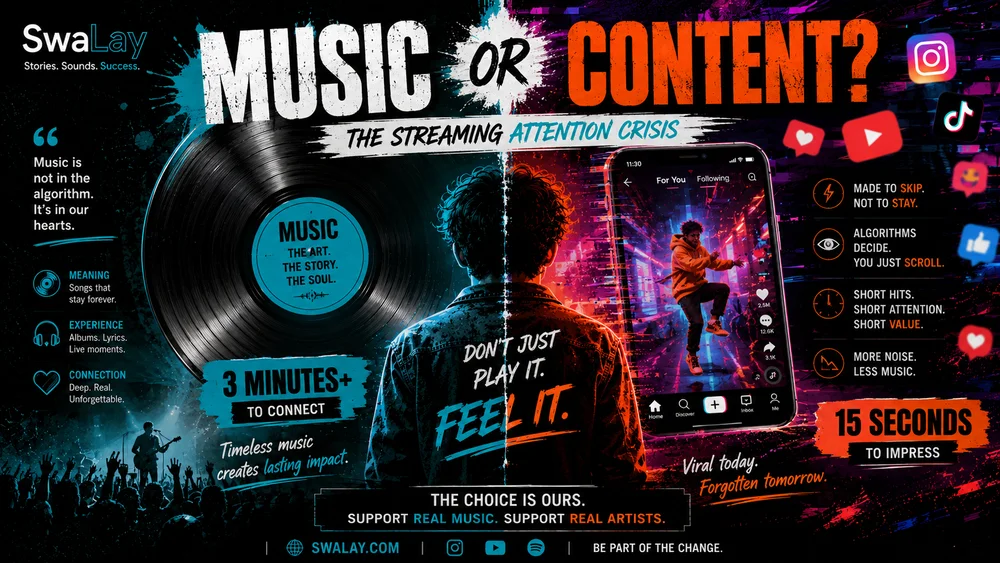
On the surface, this seems like a golden era for music.
Yet beneath the convenience lies a growing concern among artists, producers, and listeners alike.
Has music become content?
In the age of streaming platforms and short-form video, music is increasingly competing for attention rather than appreciation. Songs are being optimized for algorithms, viral moments, and replay value, often forcing artists to think less like musicians and more like content creators.
The result is a growing tension between creativity and visibility.
The Race for Attention
The modern listener has access to more music than any previous generation.
While this abundance creates opportunities for discovery, it also creates competition.
Thousands of songs are released every day.
Artists are no longer competing only with other musicians. They are competing with podcasts, videos, social media feeds, gaming platforms, and every other form of digital entertainment.
Attention has become the industry's most valuable currency.
And attention is becoming harder to earn.
Why Songs Are Getting Shorter
One of the clearest signs of this shift can be seen in song structure.
Many modern tracks reach the chorus faster than ever before.
Intros are shorter.
Songs end sooner.
Hooks arrive within seconds.
These changes are not necessarily creative decisions—they are often strategic ones.
Streaming platforms reward repeat listens, while short-form content platforms reward immediate engagement.
Artists know that if listeners lose interest in the first few seconds, they may never return.
As a result, songs are increasingly designed to capture attention instantly.
The Pressure to Go Viral
For many independent artists, making great music is no longer enough.
They are expected to become marketers, content creators, editors, and influencers.
A song's success may depend as much on a viral clip as on its musical quality.
This pressure has created a new challenge for artists.
Should they create music they believe in?
Or create music that performs well on algorithms?
The answer is rarely simple.
Going viral can change a career overnight.
But chasing virality can also influence creative decisions in ways that compromise artistic identity.
What Listeners Are Losing
While audiences benefit from endless choice, something valuable may be getting lost.
Music was once experienced more intentionally.
Albums were listened to from beginning to end.
Artists were discovered through recommendation, radio, or live performances.
Today, songs often appear in fragments.
A fifteen-second clip becomes the introduction.
A trend becomes the context.
The music arrives after the content.
For some listeners, this creates discovery.
For others, it creates distraction.
The Independent Artist Perspective
Independent musicians often feel these pressures most intensely.
Without major marketing budgets, visibility can be difficult to achieve.
Algorithms influence discovery.
Platforms influence behavior.
Audience expectations evolve rapidly.
Yet many independent artists continue to resist the pressure to create solely for engagement.
Instead, they focus on storytelling, authenticity, and long-term connection.
Their success suggests that audiences still value genuine artistic expression.
Even in an attention-driven world.
The SwaLay Perspective
At SwaLay, we believe technology should help music reach people—not redefine what music is allowed to become.
Innovation has opened extraordinary opportunities for artists and listeners.
But music's greatest strength has never been its ability to go viral.
Its strength lies in its ability to move people.
The challenge for the modern music industry is not choosing between art and technology.
It is finding a balance between creativity and attention.
Because when music becomes nothing more than content, everyone loses.
And when artists are given the freedom to create without constantly chasing algorithms, music has the power to become something far more meaningful.