
Artificial intelligence is no longer a futuristic concept in the music industry.
Today, AI can generate melodies, write lyrics, produce instrumentals, mimic famous voices, and even create complete songs within minutes.
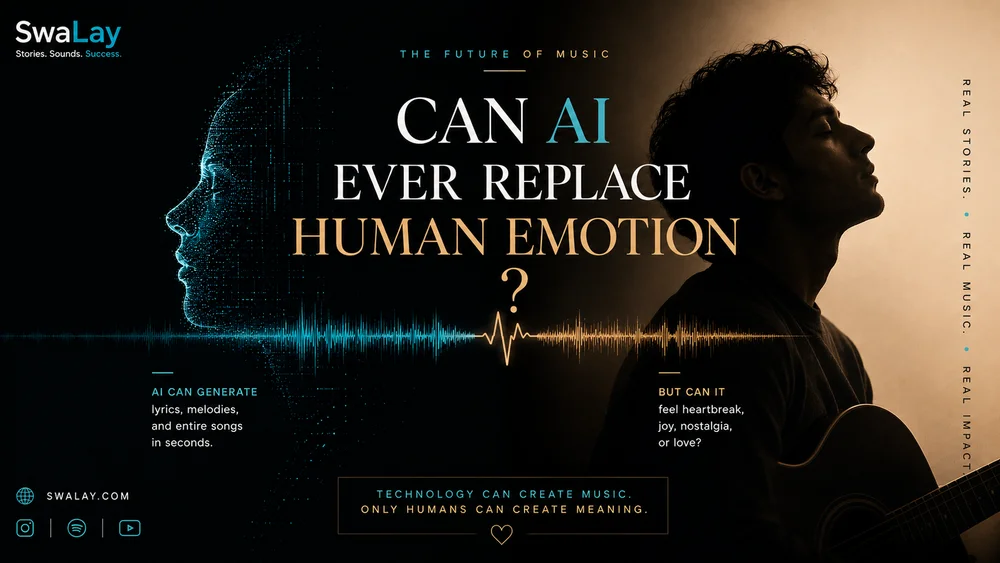
What once required a team of musicians, producers, and engineers can now be accomplished with a few prompts and powerful algorithms.
The technology is impressive.
Sometimes even astonishing.
But as AI continues to reshape the creative landscape, one question remains at the centre of the conversation:
Can AI ever replace human emotion in music?
The answer may define the future of creativity itself.
The Rise of AI Music
Over the past few years, artificial intelligence has rapidly become part of the music-making process.
Artists use AI tools to generate ideas, explore sounds, and streamline production.
Record labels are experimenting with AI-powered workflows.
Listeners are increasingly encountering AI-generated music without even realising it.
In many ways, AI has become a powerful creative assistant.
It can analyse patterns.
It can predict trends.
It can imitate styles.
It can generate content at extraordinary speed.
But creativity has never been only about patterns.
Music is something deeper.
Why Music Matters
People do not fall in love with songs because they are technically perfect.
They fall in love with songs because they feel something.
A melody can remind someone of their childhood.
A lyric can capture a heartbreak they never knew how to explain.
A voice can make a listener feel understood during difficult moments.
These emotional experiences are what make music meaningful.
And they come from human lives.
From memories.
From failures.
From love.
From loss.
From experiences that cannot simply be calculated.
Can AI Understand Emotion?
AI can recognise emotional patterns.
It can analyse millions of songs and identify which melodies sound sad, hopeful, romantic, or uplifting.
It can replicate those patterns convincingly.
But recognising emotion is not the same as experiencing it.
An AI system has never fallen in love.
It has never felt heartbreak.
It has never experienced grief, loneliness, excitement, or nostalgia.
It can imitate the language of emotion.
But it cannot live the emotion itself.
This distinction may be more important than any technological breakthrough.
The Difference Between Creation and Simulation
When listeners hear a deeply personal song, they connect with more than just the sound.
They are connecting with a story.
The song reflects a real experience shared by another person.
That connection creates authenticity.
AI can simulate a story.
Human artists live one.
And audiences are surprisingly good at sensing the difference.
As technology improves, AI-generated music may become increasingly difficult to distinguish from human-created music on a technical level.
But emotional authenticity is not measured solely by technical quality.
It is measured by meaning.
The Opportunity for Artists
Rather than viewing AI as a replacement, many musicians see it as a tool.
Just as synthesisers, digital workstations, and streaming platforms transformed music creation, AI may become another instrument in the creative process.
Artists can use AI to:
Generate ideas
Explore arrangements
Speed up production
Experiment with sounds
Enhance creativity
The key difference is that the human remains at the centre of the process.
Technology can assist creativity.
It cannot replace the human perspective that gives art its emotional value.
Why Authenticity Will Matter More Than Ever
Ironically, the rise of AI may increase the value of authentic human expression.
As audiences become surrounded by machine-generated content, genuine stories may become even more meaningful.
Listeners may place greater importance on artists who share real experiences, personal perspectives, and emotional honesty.
In a world where anyone can generate a song, authenticity becomes the true differentiator.
The future may belong not to artists who compete with AI, but to artists who embrace what AI can never fully replicate:
Being human.
The SwaLay Perspective
At SwaLay, we believe technology should empower creativity, not replace it.
AI is opening exciting possibilities for musicians around the world.
It can make music creation more accessible, efficient, and innovative.
But music has never been defined solely by technology.
Its power comes from connection.
From vulnerability.
From shared experiences.
From emotions that resonate across cultures and generations.
AI may learn to create songs.
But the stories behind those songs will always belong to people.
And as long as audiences seek understanding, comfort, and connection through music, human emotion will remain the industry's most valuable instrument.
The future of music may include AI.
But its heartbeat will always be human.